


Fighting Coastal Erosion: How the Indian River Inlet Sand Bypass System Works
“The ocean stirs the heart, inspires the imagination and brings eternal joy to the soul.” – Robert Wyland
When I first worked on the Indian River Inlet Emergency Beach Replenishment starting in 2024, I was fascinated. I had never heard of a Sand Bypass system that could literally move sand from one beach to another using pumps, an eductor that acts like a jet pump, and powerful suction. It sounded like something out of science fiction, but it is very real.
The system was installed in the 1980s by the U.S. Army Corps of Engineers (USACE) to fight erosion at the inlet. The problem started decades earlier when sand along Delaware’s coast naturally moved from south to north, carried by wave action in a process called littoral drift. In 1934, the first bridge (Route 1) across the inlet was built to connect Delaware Route 1 to local roads. Soon after, in the late 1930s, the U.S. Army Corps of Engineers built a stone jetty on both sides of the inlet to keep the channel stable.
While the jetties succeeded in keeping the channel open, they also blocked the natural movement of sand. Each one stretches hundreds of feet into the ocean, interrupting littoral drift and starving the north beach of sand. Over the years, the north beach experienced severe erosion, a problem made worse by Delaware’s low elevation and high vulnerability to sea level rise.
The solution was the Indian River Inlet Sand Bypass System. When it is working at full capacity, the system moves about 100,000 cubic yards of sand each year from the south beach to the north beach. The north beach loses about 135,000 cubic yards of sand annually due to a combination of natural erosion and human-driven climate change. Even though the bypass system does not replace all of the lost sand, it plays a critical role in slowing down erosion.

What makes this system unique is its mobility. It is the only one of its kind in the United States, according to Kathleen Bergin, a program manager with Delaware’s Department of Natural Resources and Environmental Control (DNREC).
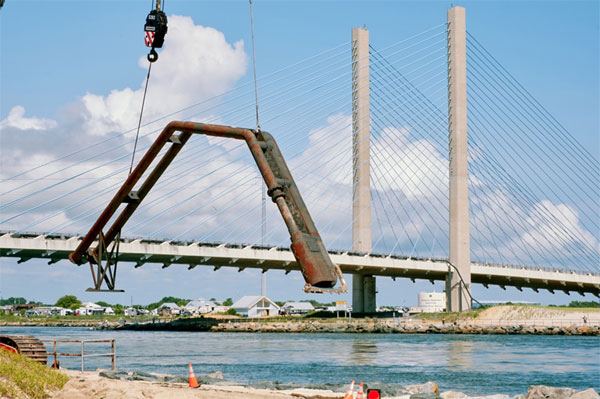
The process is both clever and complex. It begins with water being drawn from the inlet and sent to a pump house on the south beach. From there, the water flows to the eductor, a vacuum-like device suspended by a large crane. The eductor uses high-pressure water to loosen and suck up sand, creating a mix of sand and water called slurry. This slurry travels through pipes that run across the Indian River Bridge and is deposited on the north beach to replenish the shoreline.
The bypass system ran successfully for decades under DNREC’s operation until 2019, when the aging equipment failed. Repairs were delayed due to the COVID-19 pandemic and the high cost of replacement parts (the engine alone costs about 300,000 dollars). In August 2024, an emergency replenishment was initiated by DNREC and USACE after a dune breach at the Indian River Bridge.
A complete replenishment is planned for fall 2025 by the USACE following earlier repair work by DNREC. This is when I became directly involved in the project, analyzing the grain sizes of sand to ensure it matched the natural beach material.
The good news is that the sand bypass system officially restarted on July 14, 2025. For now, DNREC is running it at a lower capacity to test the new pumps and motors before introducing large amounts of sand. It is a cautious but promising step in protecting Delaware’s coastline.
This project has been much more than a typical assignment. It has been a front-row seat to seeing how innovative coastal engineering can blend history, science, and problem-solving to work with nature rather than against it.


